


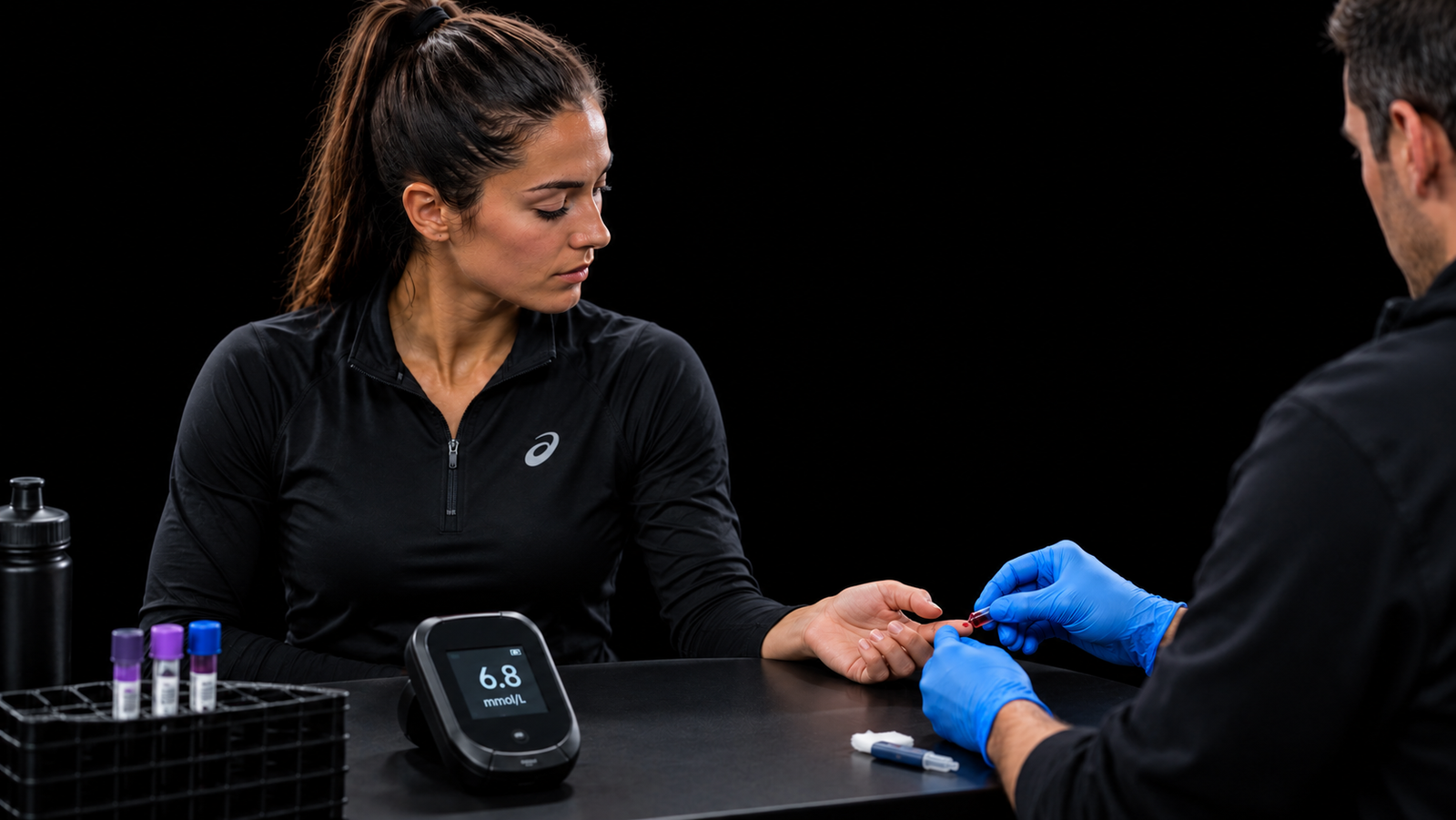
Blood Lactate Concentration Post-Exercise
Post-exercise blood lactate measurement complements the lactate curve obtained during the incremental protocol. It provides information on the true intensity of the effort performed, the glycolytic contribution to energy production, and the capacity for metabolic recovery.
Sampling Protocol
Capillary blood samples are collected from the fingertip or earlobe using the Arkray Lactate Pro 2 immediately at exercise cessation and at 1, 3, 5, 7, and 10 minutes of recovery. Peak blood lactate typically occurs between the 3rd and 8th minute post-exercise, reflecting the time required for lactate to diffuse from muscle tissue into the circulation. The first blood drop is discarded to prevent sweat contamination.
Derived Parameters
- Peak Blood Lactate (Lapeak ): The highest concentration recorded during the recovery period.
- Net Lactate Accumulation (ΔLa): Lapeak minus resting lactate, reflecting the magnitude of the glycolytic response.
- Lactate Clearance Kinetics: The rate of decline in blood lactate during recovery, expressed as a slope (mmol/L/min) or half-life.
- Lapeak vs. Final-Stage Lactate: The relationship between peak post-exercise lactate and the concentration at the last exercise stage, indicating whether the final effort was truly exhaustive.
Reference Values
Indicative values; dependent on protocol, population, and training status.
- Resting: 0.8–1.5 mmol/L.
- Maximal incremental test in endurance-trained individuals: approximately 8–12 mmol/L.
- Individuals with a power-oriented or highly glycolytic profile: occasionally >12–15 mmol/L.
- Low Lapeak following a nominally maximal effort: may indicate premature termination, accumulated fatigue, or glycogen depletion.
Clinical & Performance Utility 1
- Verification of maximal effort. A post-exercise lactate concentration >8 mmol/L is a widely used secondary criterion for VO2 max attainment, alongside a VO2 plateau, RER ≥1.10, and near-maximal heart rate. It is not sufficient on its own but increases confidence in the validity of the test.
- Metabolic profiling. A high Lapeak suggests a strong glycolytic capacity, characteristic of sprint and intermittent-sport athletes, whereas a moderate Lapeak combined with high endurance performance suggests a predominantly oxidative profile. This informs the distribution of training intensities.
- Assessment of recovery capacity. Faster lactate clearance reflects greater oxidative capacity and buffering efficiency, which is particularly relevant for sports characterized by repeated high-intensity efforts, such as padel, tennis, and combat sports.
- Individualization of training prescription. Interpreted alongside LT1 and LT2, post-exercise lactate dynamics help to calibrate high-intensity interval prescription and work-to-rest ratios.
- Monitoring adaptation and fatigue. A reduced Lapeak at an equivalent workload may indicate accumulated fatigue or overreaching, whereas progressively faster clearance across serial assessments indicates positive training adaptation.
Methodological Considerations
Post-exercise lactate is influenced by test protocol (stage duration, ramp rate, increment size), nutritional status and muscle glycogen availability, fatigue state, hydration, and recovery modality (active vs. passive). Results should always be interpreted in conjunction with VO2 , RER, heart rate, and threshold data, and never in isolation.
Towards A Better Lifestyle
Contact Us At:
+974 7082 2568
Email:
Drnidhal@azmperformancelab.com
Towards A Better Lifestyle
Contact Us At:
+974 7082 2568
Email:
Drnidhal@azmperformancelab.com
©2026. AZM. All Rights Reserved.